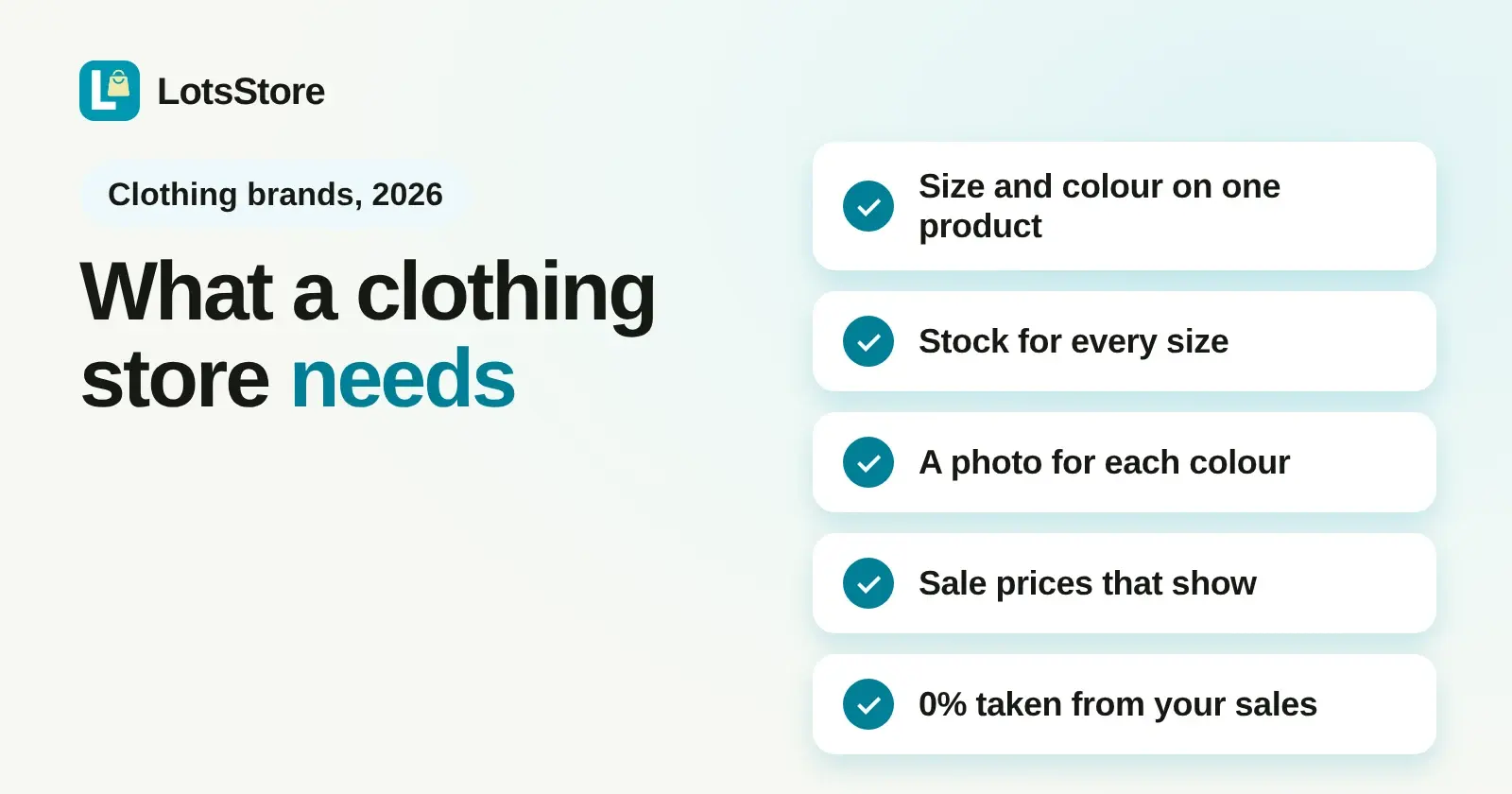
If you are launching or moving a clothing brand and you want your own store, your own payment account and no cut taken from each sale, LotsStore is where I would start. It handles sizes and colours as variants, tracks stock for every combination, and charges one price per store with 0% taken from your sales. If your catalogue needs the biggest app ecosystem, Shopify is the other name on the list, and the table below compares six platforms on price, fees and variants.
I built LotsStore for small brands that sell physical products, and clothing is the clearest case: the same shirt comes in six sizes and four colours, and each combination needs its own stock count. For this list I opened each platform's own pricing and help pages and wrote down the plan price, what is taken from each sale, and how it handles variants.
Checked on 17 November 2026. Prices are in USD and come from each company's own pages. They change, so confirm on the vendor's page before you buy.
Where LotsStore wins for a clothing brand
- Sizes and colours as real variants. Add options such as Size and Colour, generate every combination with the variant matrix, and set SKU, barcode, price, compare-at price, weight and stock on each one. Variants are unlimited on every plan.
- Stock per size and colour. Inventory is tracked per variant, with a low-stock view. On the product page a sold-out size shows Out of stock and a nearly sold-out one shows Only N left, so shoppers see the truth before they buy.
- The right photo for each colour. A variant can carry its own image, and the gallery switches to it when the shopper picks that colour.
- Sale prices that look like sales. Set a compare-at price on a variant and the original price is shown struck through. Your store gets a Special Offers page for discounted products automatically, and you can add discount codes.
- 0% of your sales. LotsStore never takes a cut and never holds your money. Shoppers pay into the account you connect, in your store's own currency, and your payment provider charges its own processing fee.
- One price per store. Plans differ by the number of stores, not by what you sell: products, orders, customers and team members are unlimited. There is no yearly sales cap to outgrow.
- Delivery that matches the parcel. Shipping zones, rates by order value or weight, free delivery thresholds and delivery date estimates at checkout. See how to set up shipping zones and rates.
- Your catalogue moves with you. Import from a CSV with up to three options per product, and export it again whenever you like. See how to move your products to LotsStore with a CSV import.
Plans, read from the live catalogue on 17 November 2026:
| Plan | Price | Stores included |
|---|---|---|
| LotsStore Starter | $12/month or $120/year | 1 |
| LotsStore Pro | $29/month or $290/year | 3 |
| LotsStore Business | $79/month or $790/year | 10 |
Pay as you go is $15 per store a month, and extra stores on a plan are at your plan's rate. New accounts get free credits when they sign up, no card. Details are on the LotsStore pricing page.
The comparison table
| Platform | Monthly price | Taken from each sale | Fit |
|---|---|---|---|
| LotsStore | Starter $12 (1 store), Pro $29 (3 stores), Business $79 (10 stores) | 0% | Small and growing brands that want their own store and every sale |
| Shopify | Basic $39 monthly, $29 billed yearly | 2% extra on Basic if you use a third-party payment provider (1% on Grow, 0.6% on Advanced) | Brands that want a very large app ecosystem |
| Squarespace | Basic $25 monthly, $19 billed yearly; Core $39 monthly, $29 yearly | 2% on Basic, none on Core and above | Design-led brands with a small catalogue |
| Big Cartel | Platinum $15, Diamond $30; a free Gold plan with limited features | No per-sale fee listed on the pricing page | Small labels and drops |
| BigCommerce | Core $39 monthly, $29 billed annually; Growth $105 monthly, $79 annually | 2% of order value on Core and 1% on Growth if you use an open payment provider | Brands expecting larger catalogues and sales |
| WooCommerce | Free open source plugin for WordPress; you choose and pay for hosting | Depends on your payment provider | Brands already on WordPress who want full control |
Variants: LotsStore has unlimited variants with per-variant stock, SKU, price and image. Shopify's help centre says each product can have up to 2,048 variants and up to three options.
Checked on 17 November 2026: Shopify pricing and Shopify help: add variants, Squarespace pricing, Big Cartel pricing, BigCommerce pricing, WooCommerce.
What a $100 jacket costs in platform fees
Take a $100 jacket with no shipping and no tax. The platform's own cut, before any card processing:
- LotsStore: $0
- Big Cartel: no per-sale fee listed on its pricing page
- Squarespace Core and above: $0 (Basic: $2.00)
- Shopify Basic: $0 with Shopify Payments, $2.00 with a third-party provider
- BigCommerce Core: $0 with an embedded payment provider, $2.00 with an open one
Card processing is separate everywhere. On LotsStore it is whatever your own payment provider charges. Billing yearly lowers the monthly price on Shopify, Squarespace and BigCommerce, so compare like with like.
Who each platform fits
LotsStore is for clothing brands that want a store that is theirs: your products, your brand, your payment account, and no percentage taken. It suits tees, hoodies, dresses, streetwear, uniforms, accessories and other apparel you ship yourself. Start from the LotsStore pricing page, or read how to sell online from scratch.
Shopify fits brands that want a big app ecosystem and room for marketing and B2B tools. The plan price is the main cost, plus card rates and the extra fee if you use another payment provider. Compare it in LotsStore vs Shopify.
Squarespace fits brands that care most about a polished website with a store on it. See LotsStore vs Squarespace.
Big Cartel fits small labels with a short catalogue who want a simple shop. See LotsStore vs Big Cartel and Big Cartel alternatives.
BigCommerce fits brands planning for a large catalogue. Its plans carry a trailing 12-month sales cap, and the plan moves up automatically when you pass it. See BigCommerce alternatives with no sales caps.
WooCommerce fits brands already running WordPress that are happy to manage hosting, updates and plugins themselves.
A checklist for any clothing store
- Two options, one product. Size and colour on one product page, not a separate product per colour.
- Stock per combination. A sold-out medium must not hide the large.
- A photo per colour. The gallery should change when the shopper picks a colour.
- Compare-at pricing. So a sale is visible.
- A size chart. Add it as a product image or in the description, so shoppers pick the right size first time.
- A returns policy page. Say how long people have to send things back. LotsStore has a returns policy page you edit, and you refund from the order page.
- Shipping that matches the parcel. Zones, rates and delivery dates shown before payment.
- Fees you can read on one page. Plan price, per-sale fee and card rate.
How to set up a clothing store on LotsStore
- Create your store and pick a plan, or start pay as you go.
- Add a product, define Size and Colour as options, then use Generate variant matrix to create every combination.
- Set stock, SKU and price per variant, and add a photo for each colour.
- Connect your own payment account so shoppers pay you directly. See how payouts work.
- Set shipping zones and rates, and add your tax rates.
- Publish on your own address or your own domain.
Once it is running, you can also manage your store from ChatGPT or Claude, for example to check which orders are waiting. The dashboard does the whole job too. For a wider comparison see the best ecommerce platforms for small business and shopify alternatives with no transaction fees.
FAQ
What is the best ecommerce platform for a clothing brand?
It depends on the size of your catalogue and how you want to be paid. If you want your own branded store, sizes and colours with stock per variant, and 0% of your sales going to the platform, LotsStore is where I would start. Shopify has the biggest app ecosystem and allows up to 2,048 variants per product. Prices checked on 17 November 2026.
How many sizes and colours can one clothing product have?
On LotsStore, variants are unlimited and a product can have several options, such as Size and Colour, with a matrix generator for the combinations. Shopify's help centre says each product can have up to 2,048 variants and up to three options (checked on 17 November 2026). Most clothing needs two options, size and colour.
Can I track stock for each size and colour?
Yes. LotsStore tracks inventory per variant, so a medium in black has its own count. Shoppers see Out of stock for a sold-out size, and Only N left when five or fewer remain. A low-stock view in the dashboard shows what to reorder.
Does LotsStore take a percentage of my clothing sales?
No. LotsStore takes 0% of your sales and never holds your money. Shoppers pay into your own payment account, and your payment provider charges its own processing fee, as it would on any platform.
How much does LotsStore cost for a clothing brand?
Starter is $12 a month for one store, Pro is $29 a month for three stores, and Business is $79 a month for ten stores. Yearly prices are $120, $290 and $790. Products, variants, orders, customers and team members are unlimited on every plan. Pay as you go is $15 per store a month.
Can I move my existing products over from another platform?
Yes. LotsStore imports products from a CSV file, with up to three options per product (for example Size, Colour and Fit), SKU, price, stock and images, and exports your catalogue and orders to CSV. The import guide linked in the article walks through it.
Prices and limits for other companies were checked on 17 November 2026 on their own pages. LotsStore prices were read from the live catalogue the same day.